Music is often described in terms of time. A melody unfolds over seconds, rhythms establish a pulse and harmonies change as a piece progresses. Yet music also creates another dimension that is far less obvious but just as powerful: a sense of space.
You may have experienced it without consciously thinking about it. Some pieces of music feel vast and open, as though they stretch towards a distant horizon. Others feel intimate, as if the musicians are performing in the same room as you. Although you’re only listening through headphones or speakers, your brain constructs an imaginary environment around the sounds.
This ability to create space is one of music’s greatest strengths. It allows composers and producers to shape not only what you hear, but also how you experience the world the music invites you into.
Your Brain Imagines the Spaces You Cannot See
Every day, your ears help you understand the physical world.
Without looking, you can often tell whether someone is standing nearby or across the room. You recognise the difference between speaking inside a cathedral, a small office or an open field because your brain interprets subtle acoustic clues.
These include:
- echoes and reverberation
- the direction sounds arrive from
- differences in loudness
- tiny delays between your ears
- the balance of high and low frequencies.
Your brain performs this remarkable analysis almost instantly.
When listening to music, those same mechanisms are at work. Even though the instruments were recorded elsewhere, your mind builds a convincing impression of depth, distance and size.
In many ways, you’re hearing a place that exists only through sound.
The Production Techniques That Create Musical Space
Music producers and recording engineers have many tools for shaping the illusion of space.
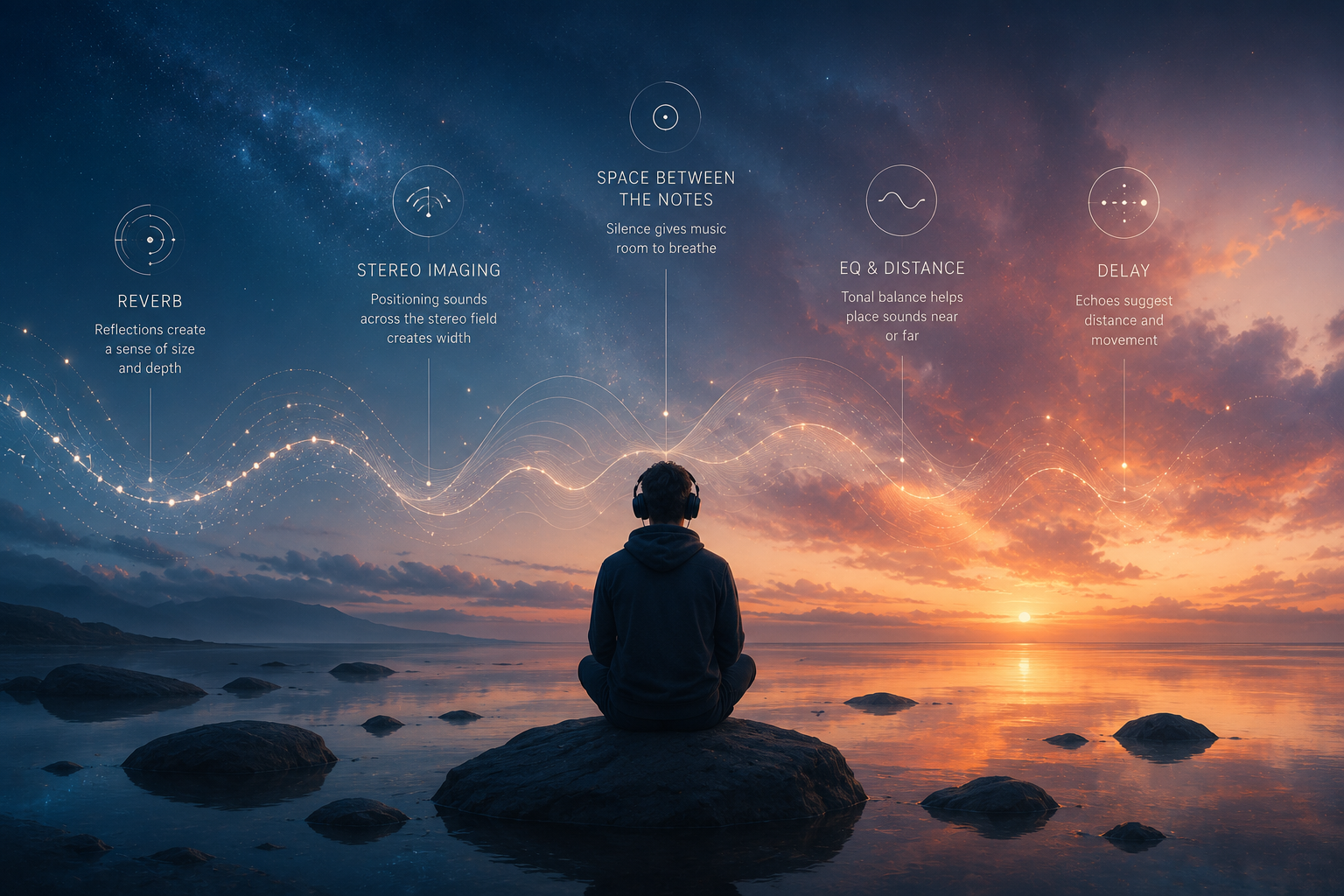
Perhaps the most familiar is reverb. In everyday life, sound reflects from walls, ceilings and other surfaces before reaching your ears. These reflections tell your brain about the size of the environment.
A dry recording, with very little reverberation, feels close and immediate.
Add a long, gentle reverb and suddenly the same sound appears to exist inside a church, a cave or an enormous hall.
Delay creates another layer of spaciousness. Repeating echoes suggest distance and movement, while subtle stereo delays can make sounds appear wider than the speakers themselves.
Producers also carefully position instruments across the stereo field. Some sounds sit directly in front of you, while others seem to emerge from the far left or right, creating width and balance.
Equalisation contributes too. Distant sounds naturally lose some of their higher frequencies as they travel through air, so gently reducing brightness can make an instrument appear further away.
Individually these techniques may seem subtle, but together they create immersive listening experiences that feel remarkably three-dimensional.
Ambient Music and the Art of Spacious Sound
Few genres explore musical space as deeply as ambient music.
Rather than filling every moment with activity, ambient compositions often leave room for sounds to breathe. Long sustained notes, evolving textures and carefully placed silences encourage your imagination to become part of the listening experience.
Instead of asking you to focus on a melody alone, ambient music invites you to notice the atmosphere surrounding it.
This approach can create a feeling of openness that many people associate with calmness, reflection and contemplation.
Pioneering ambient composer Brian Eno famously described ambient music as being able to be “as ignorable as it is interesting”. While listeners interpret this in different ways, one reason it remains influential is its ability to shape the character of a space without constantly demanding your attention.
Modern electronic producers continue this tradition, using synthesisers, field recordings, granular textures and spacious effects to create environments that feel almost tangible despite existing entirely within sound.
Why Spacious Music Can Feel Relaxing
A spacious soundscape often encourages slower, more attentive listening.
Instead of processing a rapid stream of musical events, your brain has time to absorb individual sounds and notice subtle changes. This slower pace may help reduce the feeling of sensory overload that many people experience in busy modern environments.
Research into music and emotional regulation suggests that calm, predictable music can support relaxation by influencing mood and reducing physiological arousal. Although everyone’s response differs, slower instrumental music is frequently associated with lower perceived stress and greater emotional comfort.
The feeling of spaciousness may also contribute psychologically.
Large open landscapes are often associated with freedom, possibility and tranquillity. When music creates similar impressions through sound alone, your imagination can respond in comparable ways, even though you never physically leave the room.
This may help explain why many people choose ambient music for meditation, reading, creative work or simply taking a break from the constant stimulation of daily life.
Space Exists Between the Notes Too
When people think about music, they usually think about the notes themselves.
Yet silence plays an equally important role.
Every pause allows what came before to settle. Every sustained note becomes more meaningful because it is surrounded by space rather than crowded by constant activity.
Many musical traditions recognise this principle.
Classical composers have long used silence to create tension and release. Japanese aesthetics embrace the concept of ma—the meaningful space between events—which influences music, architecture and visual art alike. In jazz, the notes left unplayed can be just as expressive as those that are performed.
Space gives music room to breathe.
Without it, every composition risks becoming a continuous stream of information with little opportunity for reflection.
Hearing Beyond the Speakers
One of the remarkable qualities of music is that it can transport you without moving you.
Through carefully shaped acoustics, subtle production techniques and thoughtful composition, music creates places that exist only within your imagination. A simple melody can feel as though it echoes across mountains, drifts through ancient forests or floats among distant stars, even while you’re sitting quietly at home.
Perhaps this is why spacious music feels so compelling. It reminds you that listening is not only about hearing individual sounds but about experiencing the environments those sounds create.
At Sonic Oneness, creating this sense of space is central to every composition. Layers of evolving synthesisers, gentle textures and carefully considered reverberation are used to build immersive soundscapes that encourage stillness, curiosity and reflection. Rather than filling every moment, the music aims to leave room for your own thoughts and imagination, allowing each listening experience to become something uniquely personal.
Recommended listening