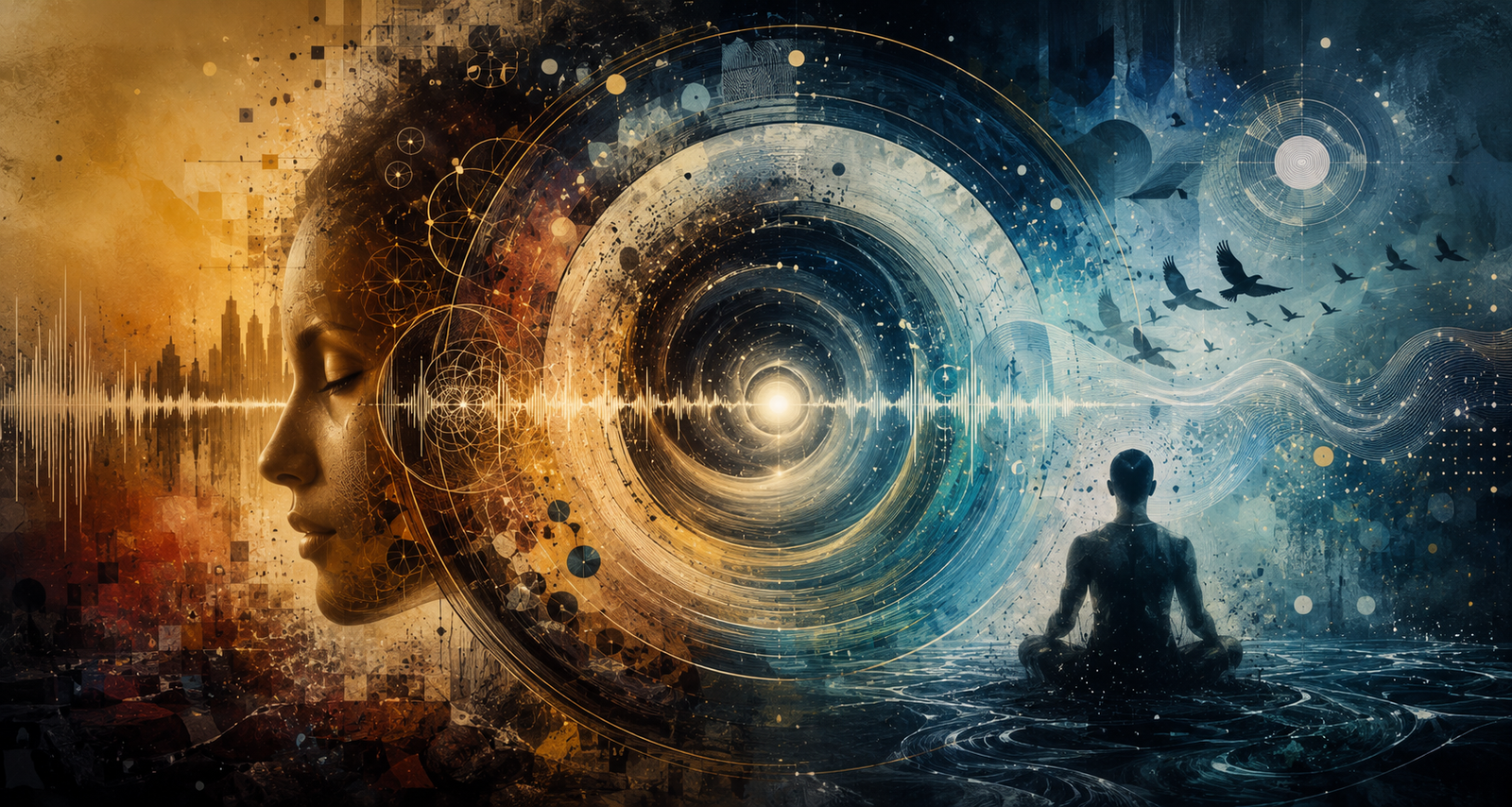
Music has an extraordinary ability to bring people together.
Across cultures, languages and generations, music creates shared experiences that transcend words. Whether it is a group of strangers singing at a concert, a community gathering around a drum circle, or a solitary listener finding comfort in a favourite piece of music, sound has a unique way of dissolving barriers and creating connection.
This raises an interesting question: what can music teach us about oneness?
For many spiritual traditions, oneness refers to the understanding that beneath the apparent differences between people, places and things, there exists a deeper interconnected reality. While this idea has been explored through philosophy, meditation and religion for thousands of years, music offers a direct and accessible way to experience it for yourself.
More Than Just Notes and Sounds
At first glance, music appears to be a collection of separate elements.
There are individual notes, instruments, rhythms, melodies and textures. Each component plays its own role within the composition.
Yet when you listen to a piece of music, you rarely focus on every individual sound separately. Instead, you experience the music as a unified whole.
A melody may stand out for a moment, or a rhythm may catch your attention, but together they create something greater than the sum of their parts.
In many ways, this mirrors life itself.
Although we appear as separate individuals with unique experiences, we are all participating in a larger interconnected system. Music reminds us that individuality and unity are not opposites. Both can exist simultaneously.
When the Sense of Separation Fades
Have you ever become completely absorbed in a piece of music?
Perhaps you were listening through headphones on a long walk, sitting quietly with your eyes closed, or attending a live performance where everything else seemed to disappear.
For a few moments, there may have been no concern about the past or future. No mental commentary. No effort.
There was simply listening.
Experiences like these are common, yet they point towards something profound.
When we become deeply immersed in music, the usual sense of separation between “listener” and “sound” can begin to soften. The music is no longer something happening outside of us. Instead, there is only the experience itself.
Many contemplative traditions describe similar states during meditation and mindfulness practice.
The Universal Language of Sound
One of the reasons music feels so powerful is that it does not rely entirely on language.
Words often divide. They depend on culture, nationality and interpretation. Music communicates in a more direct way.
A peaceful ambient soundscape can evoke calm in listeners from completely different backgrounds. A moving melody can stir emotions regardless of where someone lives or what language they speak.
This universality suggests that music touches something fundamental within human experience.
Before we are musicians, artists, professionals or members of a particular culture, we are conscious beings capable of hearing, feeling and responding to sound.
Music reminds us of what we have in common.
Nature, Sound and Interconnection
The natural world offers another example of oneness through sound.
When you sit quietly in a forest, beside a river or on a windswept coastline, countless sounds combine to create a living soundscape. Birds sing, leaves rustle, water flows and insects hum.
No single sound dominates the experience.
Together, they form a dynamic and interconnected whole.
Many ambient musicians draw inspiration from these natural environments because they reveal an important truth: harmony does not require uniformity.
The beauty emerges from diversity working together.
The same can be said for ecosystems, communities and perhaps humanity itself.
How Ambient Music Encourages Connection
Unlike music that constantly demands attention, ambient music often creates space.
Slow-moving textures, evolving tones and gentle atmospheres encourage the mind to settle and the listener to become more present.
This spaciousness allows you to experience music differently.
Rather than focusing on lyrics, structure or expectation, you may simply notice the sounds as they arise and dissolve. The experience becomes less about analysing and more about being.
At Sonic Oneness, much of my music is inspired by this principle.
Through ambient soundscapes, meditative textures and electronic atmospheres, I aim to create music that encourages reflection, presence and a sense of connection with the wider world.
The goal is not to tell listeners what to think, but to provide a space where they can explore their own experience.
What Oneness Really Means
The word “oneness” is sometimes misunderstood.
It does not mean that everyone must think the same way, believe the same things or lose their individuality.
Rather, it points towards the recognition that beneath our differences, there is a shared foundation.
Just as every note contributes to a piece of music, every person contributes to the larger symphony of life.
The individual notes remain distinct, yet the music itself is one.
Perhaps this is one of the most valuable lessons music can teach us.
Listening Beyond Music
The deeper lesson of oneness is not limited to music.
Once you begin to listen carefully, you may notice it everywhere.
In conversations where genuine understanding emerges.
In moments of stillness in nature.
In shared experiences with family, friends and strangers.
In the recognition that every sound, thought and experience arises within the same field of awareness.
Music simply offers one of the most beautiful gateways into this understanding.
We are one
Music has the power to entertain, inspire and move us emotionally, but it can also teach us something about the nature of connection itself.
By bringing many different elements into harmony, music demonstrates how individuality and unity can coexist. Through deep listening, it can soften our sense of separation and remind us of our relationship with the world around us.
Whether experienced through a live performance, a favourite album, the sounds of nature or a peaceful ambient soundscape, music offers an invitation to listen more deeply—not only to sound, but to life itself.
Perhaps that is why music continues to resonate so profoundly with us. Beneath every note, rhythm and melody lies a simple reminder: we are far more connected than we often realise.